
For nearly 50 years, the legal foundation for abortion in America rested on judicial decisions, not the democratic will of the people. The Supreme Court’s 1973 decision in Roe v. Wade, followed by Doe v. Bolton and Planned Parenthood v. Casey, imposed a nationwide abortion regime that struck down countless state protections for the unborn.
That changed in 2022, when the U.S. Supreme Court overturned Roe in Dobbs v. Jackson Women’s Health Organization, restoring the authority of states to regulate or restrict abortion. While this decision marked a critical turning point, it did not end the injustice. Instead, the legal landscape has grown even more complex: some states have enacted strong protections for life, while others—like Massachusetts—have passed laws that expand abortion access even further than Roe allowed.
Understanding the key court decisions and legislative actions that have shaped abortion law is essential to exposing this legal injustice and building a culture that respects and protects every human life.
Below is a summary of some of the most significant abortion-related court cases and state laws, including links to full documents in .pdf format.
FEDERAL CASES:
Griswold v. Connecticut (1965)— While not directly concerned with abortion, the Griswold v. Connecticut case in which a state law concerning contraceptives was overturned is one of the first cases wherein a so-called “right to privacy” found in the emanations and penumbras of the actual Bill of Rights was used to justify the socially and politically motivated decision of the majority.
Roe v. Wade (1973)— Roe is the Supreme Court case that legalized abortion in all 50 states by overturning a Texas law forbidding the procedure except under certain circumstances. Roe introduced the theoretical and unscientific use of trimesters to determine the humanity of an unborn child.
Doe v. Bolton (1973)— The Doe case is the one that expanded the finding in Roe v. Wade to essentially allow abortions under any circumstances at any time through all 9 months of a pregnancy as long as the “health” of the mother was concerned. Because of Doe, abortion is essentially legal through all 9 months in all 50 states.
Planned Parenthood v. Casey (1992)— Rather than overturn Roe, Casey reaffirmed it, replacing the trimester system with a new “undue burden” standard. It upheld some abortion restrictions but continued to block full protections for the unborn.
Dobbs v. Jackson Women’s Health Organization (2022)— The Supreme Court reversed Roe v. Wade and Casey, ruling that the Constitution does not confer a right to abortion. The Dobbs decision returned the power to regulate abortion to the states and their elected representatives, ending nearly five decades of federally imposed abortion policy.
STATE CASES:
Moe v. Secretary of Administration and Finance (1981)—This is the Massachusetts court case wherein the Supreme Judicial Court not only determined there was an absolute state right to an abortion but also that individuals had a right to have their abortion paid for with Commonwealth tax dollars. Thanks to this decision, you pay for abortions performed in Massachusetts.
STATE LEGISLATION:
ROE Act (2020)— Passed by the Massachusetts legislature in December 2020 (during the height of the COVID-19 pandemic and under public participation restrictions), the ROE Act significantly expanded abortion access in the Commonwealth. Lawmakers overrode a gubernatorial veto to enact the law, which removed the requirement for parental consent for 16- and 17-year-olds, broadened the grounds for abortion after 24 weeks, and eliminated legal protections for infants born alive after attempted abortions. Unlike earlier changes imposed by the courts, this law was enacted legislatively but under circumstances that raised serious concerns about transparency and public accountability.
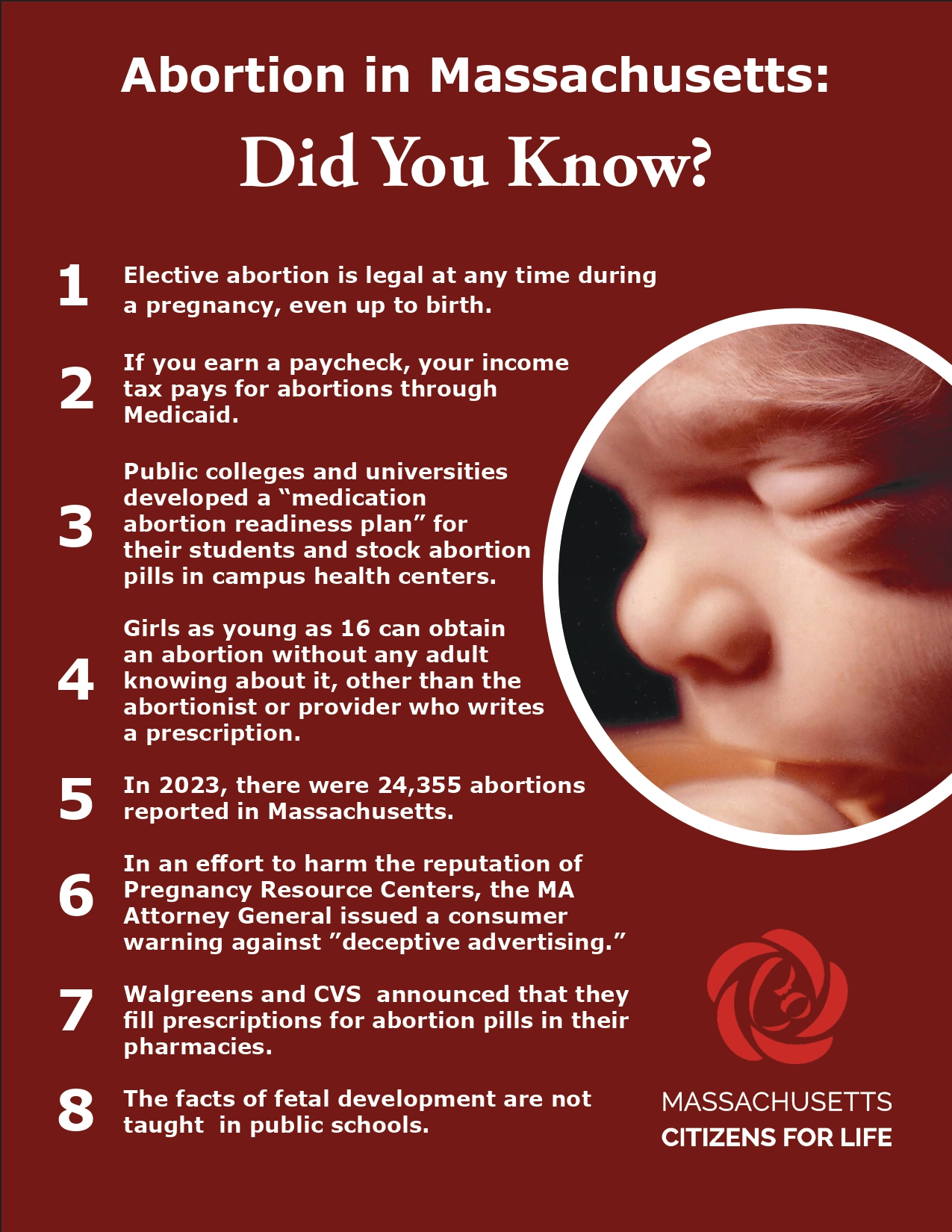
To follow current legislation under consideration in the Massachusetts Legislature and to take action, visit MCFL’s Legislative Action Center.